
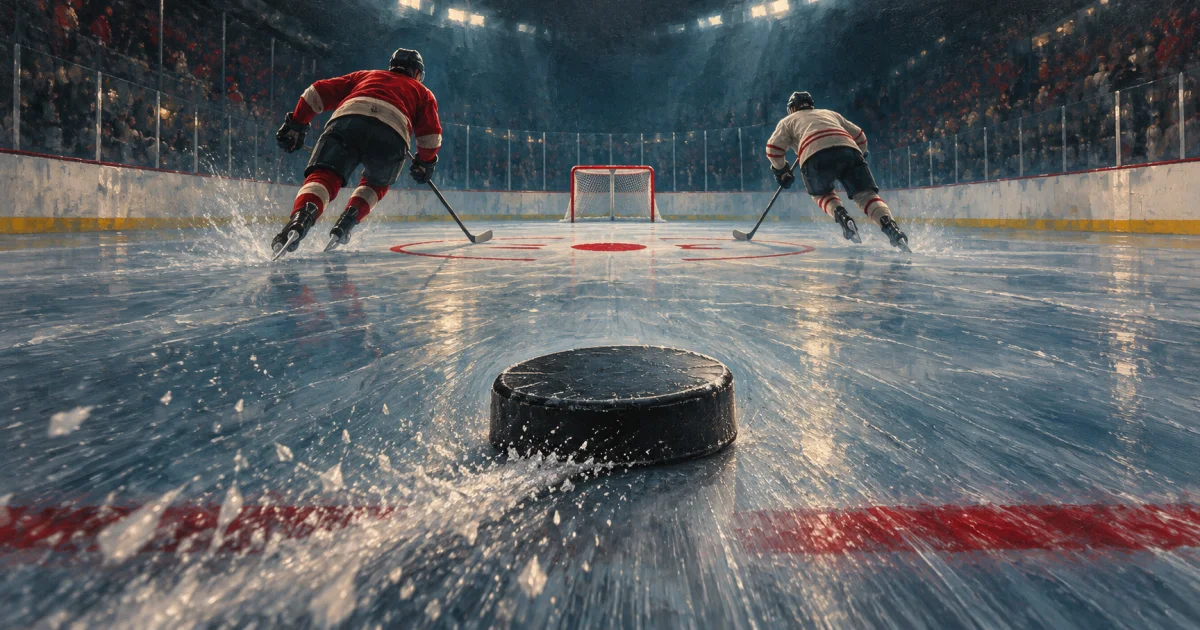
Original editorial illustration.
Learn what icing is in hockey, how NHL hybrid icing works, when it’s waved off, and what happens next—plus key youth-rule differences to watch.
The short answer
Icing in the NHL is when a team at equal or greater on-ice strength shoots the puck from its own half over the opponent’s goal line and no one touches it before it gets there. Under hybrid icing, linespersons whistle the play dead based on who would reach the puck first by the end-zone faceoff dots; if the race is too close at the dots, icing is called. That’s why you’ll see sprints to the dots rather than full touches. These standards come from NHL Rule 81, which governs the 2026–27 season.
How NHL hybrid icing works
Hybrid icing blends safety with fairness. The linesperson first judges that the puck will cross the goal line. Then they decide; no later than a player reaching the faceoff dots; whether an attacker or defender would touch it first. The player’s skate at the dots is the trigger point for the decision, but the judgment is about who would touch the puck first, not who gets to the dots first. If it’s too close at the dots, the whistle goes.
Watch for three tells during a game: a raised arm signaling a potential icing, the race toward the dots, and a quick washout motion if icing is waved off. The NHL’s video rulebook clips show the race-to-puck mechanics in context.
When icing gets waved off
Icing is waved off in several common situations:
- Goaltender involvement: If the goalie feigns playing the puck, attempts to play it, or skates toward it on a potential icing, play continues. Conversely, merely retreating to the crease without a play attempt does not cancel icing.
- Opponent could have played it: If, in the linesperson’s opinion, a skater on the defending team could have played the puck before it crossed the goal line; but chose not to; there’s no icing. Touches off any opponent (including the goalie) at any time before or after the line also nullify icing.
- Numerical strength: A shorthanded team may legally shoot the puck the length of the ice; icing does not apply if the offending team has fewer skaters than the opponent. Timing matters at penalty expiration; the ruling is based on the instant the puck is released.
What happens after an icing
Once icing is called, the faceoff comes back to the offending team’s end; and the attacking team gets to choose which end-zone circle for the draw. The defending team cannot change players before that faceoff, with limited exceptions (replacing an injured player, a goaltender who had been pulled, or after a penalty that changes on-ice strength). If the linesperson erred calling icing, the faceoff is at center ice.
Faceoff procedures also tighten after an icing. Officials will warn once for a first faceoff violation; subsequent violations can lead to a bench minor for delay of game. This stricter approach is meant to keep the game moving after an icing stoppage.
Common misunderstandings, clarified with examples
A few frequent mix-ups:
- “My skate over the red line cancels icing.” Not quite. To “gain the line” and avoid icing, the puck; on the puck carrier’s stick; must make contact with the center red line; skate position alone doesn’t do it.
- “Goalies have to touch it to wave it off.” They don’t. If the goalie feigns or moves to play the puck on a potential icing, officials can let play continue even without contact.
- “Any deflection cancels icing.” Only certain ones do. Deflections off opponents (or the goalie) wipe it out; pucks deflecting solely off the shooting team don’t. If the race to the dots is too tight to call, icing stands.
Two quick hypotheticals: A defender peels off the wall, clearly able to play a slow rim before the line, but lets it go; that’s no icing. A tired team at even strength ices the puck with 1:10 left; they must stay on for the defensive-zone draw the attackers choose.
Youth and other-league differences you should know
This guide uses NHL rules and the league’s official 2026–27 rulebook. Other competitions can use different icing procedures or shorthanded exceptions. A rule learned at a youth game may therefore differ from the call you see on an NHL broadcast.
For a new viewer, focus on three things: where the puck was released, whether anyone could or did play it, and which team the linesperson judges would reach it first. After the whistle, notice the defensive-zone faceoff and the restriction on the offending team’s line change. Those consequences explain why tired players work so hard to avoid icing.