
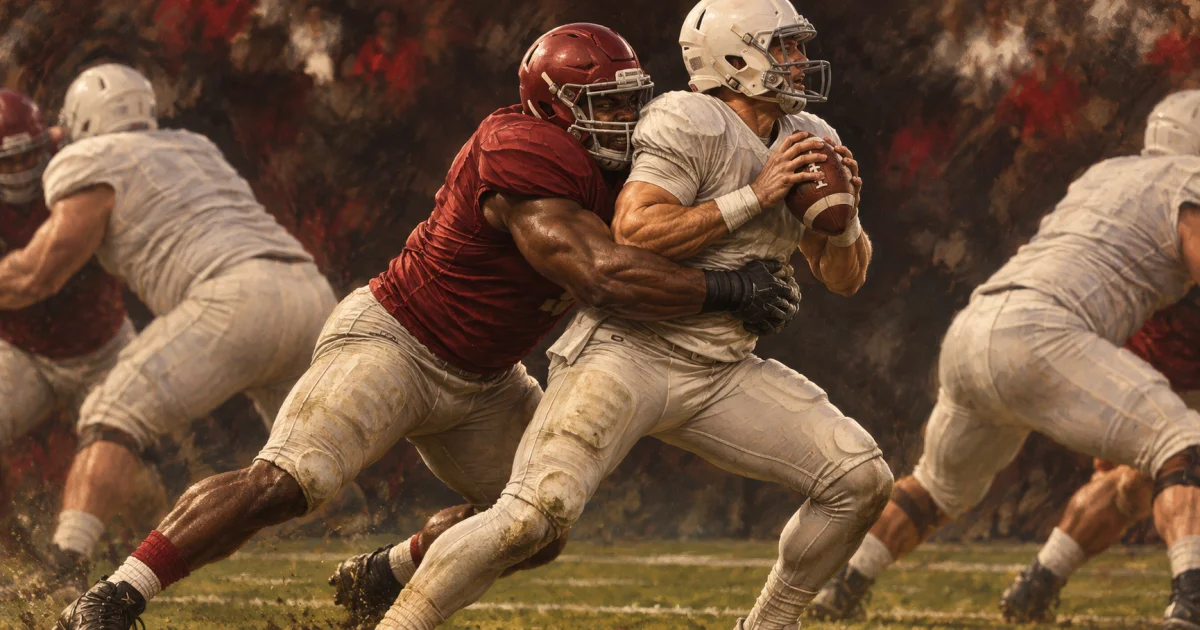
Original editorial illustration.
An NFL-focused explainer of sacks: what they are, how they’re credited and measured, when plays don’t count as sacks, and why they swing drives.
The short answer
A sack is when the defense tackles the quarterback (or any passer) behind the line of scrimmage on a pass play before a forward pass is thrown.
In NFL stat-keeping, the key is that it’s a pass play. If the quarterback is trying to pass and is brought down in the backfield, it’s a sack. A loss on a designed quarterback run is generally a rushing loss. On a broken pass play, tucking the ball alone does not automatically stop the play from being recorded as a sack. This explainer uses NFL rules and conventions in the 2026 NFL Rulebook.
How a sack is scored in the NFL
- Credit goes to the defender who brings the passer down. If two defenders share the takedown, they split it as 0.5 sacks each; by rule, only two players can share credit on one sack.
- Sack yardage is recorded as yards lost “attempting to pass,” which subtracts from the team’s net passing yards. That convention dates to the league’s effort to separate gross from net passing by accounting for backfield losses on pass plays.
- Sacks have been an official NFL individual statistic since 1982. Team sacks are also tracked, and league publications list team and individual totals each season.
These conventions come from the NFL’s own historical/statistical materials and are reflected in the league’s annual Record & Fact Book and club media guides.
What is not a sack (common confusions)
A designed quarterback draw that loses three yards is normally a rushing loss, not a sack. The offense was trying to run from the start. By contrast, a quarterback who escapes pressure on a called pass and is tackled behind the line can still be charged with a sack even after tucking the ball.
A legal incomplete throw does not become a sack merely because the quarterback was pressured. Intentional grounding is a penalty, and its statistical treatment is a separate question; it should not be reduced to the claim that grounding can never involve sack credit.
The key is to distinguish the official’s ruling from the statistical classification. A referee decides whether the ball is live, where the play ends and whether a foul occurred. The official game statistics determine the credited sack, rushing loss and yardage.
How sacks affect yardage and downs
Think of sack yardage as negative passing. Suppose, hypothetically, a team throws for 210 gross yards but suffers three sacks for a total loss of 18 yards. Its net passing would be 192 yards (210 − 18). That arithmetic example shows why sacks shrink passing output even when completions look good.
Drive math changes quickly. A hypothetical 1st-and-10 at the 35 becomes 2nd-and-17 after a 7-yard sack, narrowing the playbook and increasing the defense’s advantage on subsequent downs.
Why sacks matter strategically
- Field position and scoring: Sacks often push offenses out of field-goal range. A single 8–10 yard loss can turn a 52-yard try into a punt.
- Turnover risk: Pressure that produces sacks also produces strip-sacks and hurried throws. Even without a turnover, a sack’s lost yardage forces lower-percentage plays on long downs.
- Individual impact: Edge rushers and interior disruptors build value through sacks and pressures. Because sacks are tracked precisely and have been official since 1982, they anchor how teams, media and awards voters compare pass rushers year to year.
What to watch during a game
Want to spot a sack developing in real time?
- Start with the line of scrimmage. If the QB still has the ball behind it and protection is losing, a sack is on the table.
- Watch the QB’s intent. If he’s scanning and cocking to throw, he’s a passer; a tuck or scramble behind the line can still finish as a sack. Check the official play-by-play when the classification is unclear.
- Track the finish. One defender finishing the play usually gets full credit; if two meet at the QB, expect a split. Yardage lost is measured from the snap spot to where the passer is ruled down.
These cues, grounded in NFL rules and stat practices, will help you tell quickly whether the backfield takedown will show up as a sack or something else on the stat sheet.