
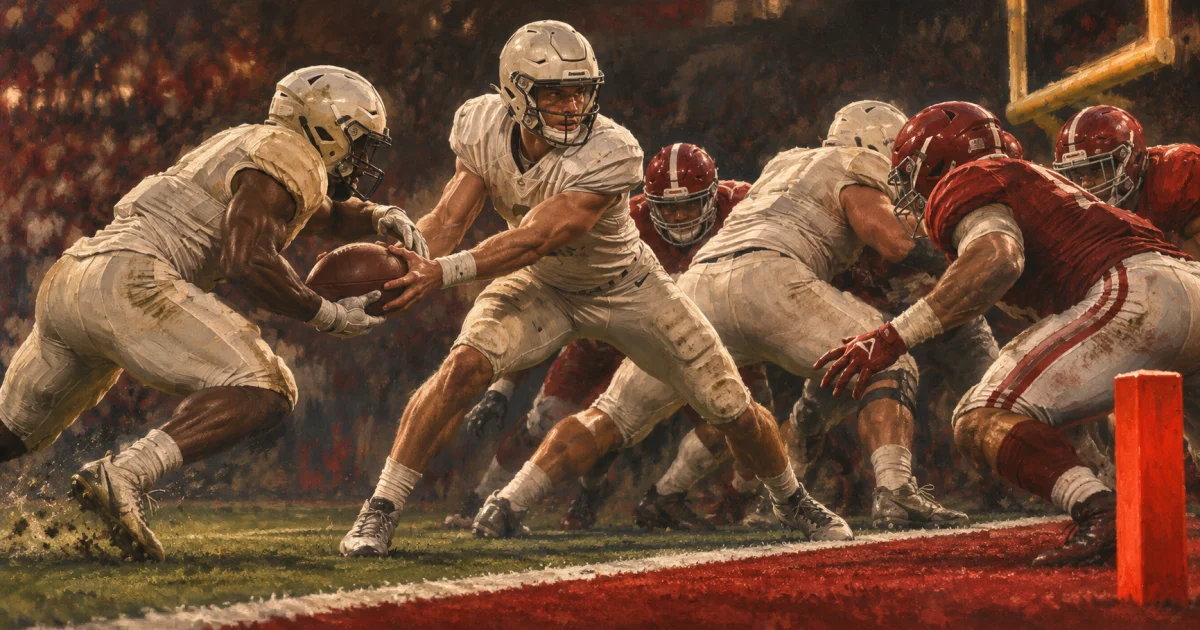
Original editorial illustration.
Learn how NFL two-point conversions work, where the ball is spotted, why coaches attempt them, and how college football handles the try differently.
The short answer
A two-point conversion is a post-touchdown play where the offense runs or passes from close to the goal line to score two points instead of kicking an extra point for one.
Under the 2026 NFL rulebook, the two-point try is a special untimed down taken from the 2-yard line; a successful run or pass equals two points. The alternative one-point kick is snapped from the 15-yard line. The defense can also return a turnover on the try for two points of its own. These provisions come from Rule 11 on the Try.
Where the ball is spotted and how the NFL Try works
The NFL calls this post-touchdown play the Try. It’s an untimed down; the game clock does not run. After a touchdown, the scoring team chooses either a kick from the 15 (worth one) or a scrimmage play from the 2 (worth two). The Try ends when either team scores or the ball becomes dead. If any try play results in a touchback, it’s simply no good and there’s no replay of the attempt.
Penalties are administered with special options. For example, many fouls are enforced on the ensuing kickoff, while certain defensive fouls can create a re-try. Details live in Rule 11’s penalty items.
Strategy in plain numbers (hypotheticals)
Coaches go for two when the expected value and game context make it worthwhile. For a hypothetical comparison, a two-point play with a 48% success chance has an expected scoring value of 0.96 points: 2 × 0.48. A one-point kick with a 97% success chance has an expected value of 0.97 points. That small average difference is only one part of the decision; the score and possessions remaining can matter more.
Endgame arithmetic is situational. Down 14 late in the fourth, some coaches try for two after the first touchdown to learn whether a second touchdown must be paired with another two-point play. That knowledge can change how you call subsequent plays. These numbers are examples only; real decisions depend on your team’s success rates and opponent tendencies.
Common misunderstandings, cleared up
- “Blocked extra points are dead.” Not in the NFL: during the Try, if the defense gains possession, it can return the ball for two points.
- “The clock runs during conversions.” The Try is an untimed down; no game clock runs.
- “Every touchback spots the ball the same.” Touchbacks during a Try simply end the Try with no replay; that’s unique to this down and differs from other phases.
- “All reviews require a coach’s challenge.” Try plays are subject to booth-initiated review by the Replay Official; coaches don’t need to challenge.
What to watch during a game
Before the snap, scan who’s on the field. Heavy personnel near the goal line often hints at a power run; spread sets and stacks signal rub routes or quick perimeter throws.
Watch motion and alignment. Compressed splits can create traffic for defenders; motion can isolate a favorable matchup or reveal man-versus-zone coverage.
Track the edge. A free rusher can blow up a two-point try; conversely, a quarterback keeper off a zone-read can beat overaggressive contain.
After flags, listen for the referee’s options. Some defensive fouls lead to a re-try or a choice to carry yardage to the kickoff; unsportsmanlike conduct commonly carries over to the kickoff.
How college rules differ
College rules are similar but not identical. NCAA tries are generally snapped from the 3-yard line (the NCAA statistics manual’s examples and penalty enforcement reference this base spot). Defensive returns on tries can score two, just like the NFL.
Overtime also diverges. Beginning with the third overtime, NCAA games shift to alternating two-point plays only, so every possession from that point is a two-point conversion attempt. The NCAA has reiterated this format in recent rules communications.
If you’re watching college football, remember that league mechanics and distances differ from the NFL; always consider the competition level when comparing two-point strategies.