
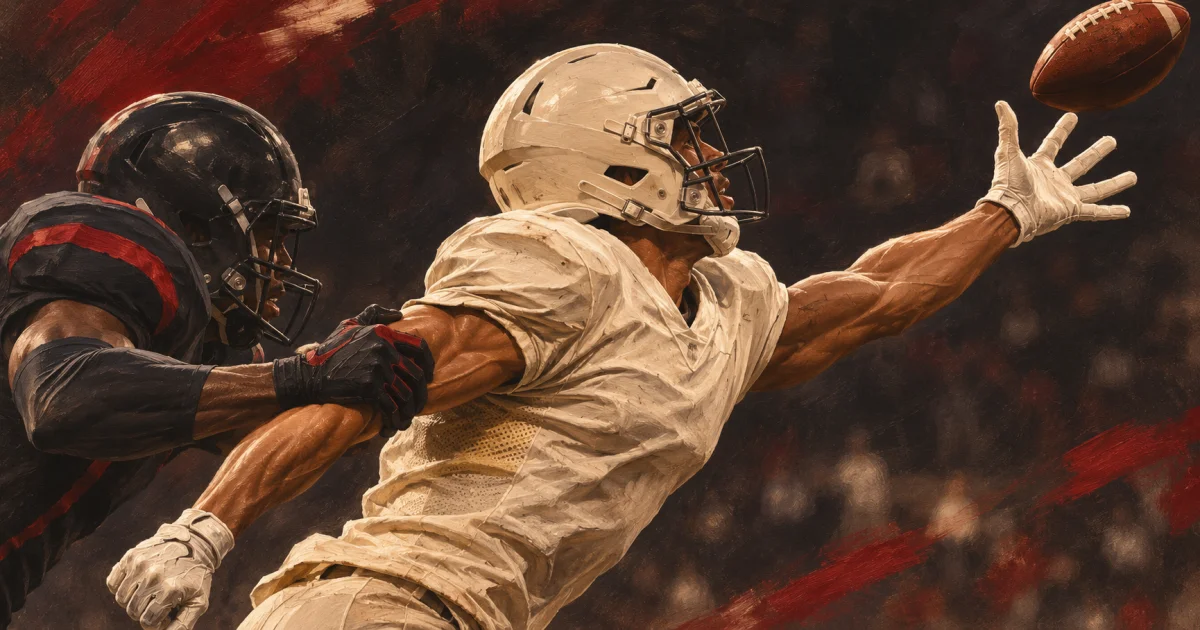
Original editorial illustration.
NFL pass interference, explained fast: what triggers defensive vs offensive PI, how penalties are enforced, common myths, and what to watch live.
The short answer
In the NFL, pass interference (PI) is when a player more than one yard beyond the line of scrimmage significantly hinders an eligible receiver’s opportunity to catch a forward pass thrown from behind the line. The 2026 NFL rule applies whether that pass is legal or illegal and whether or not it crosses the line of scrimmage.
Defensive pass interference (DPI) is enforced at the spot of the foul and gives the offense a first down. If the contact occurs in the defense’s end zone and the previous snap was outside the defense’s 2‑yard line, the ball is placed at the 1. If the previous snap was inside the 2, it’s half the distance to the goal, first down.
Offensive pass interference (OPI) is a 10‑yard penalty from the previous spot, with the down repeated when that penalty is accepted. These standards are from the NFL’s 2026 Official Playing Rules (Rule 8, Section 5).
When contact is and isn’t interference
Defensive pass interference applies while the pass is in flight; earlier defensive contact may instead be holding or illegal contact. Offensive pass interference has a different window, beginning at the snap. Once the pass is in the air, both eligible receivers and defenders have an equal right to the ball but cannot restrict the other’s ability to make the catch.
Permissible actions include incidental hand‑fighting that doesn’t control or turn the opponent, inadvertent tangling of feet, and physical contests for position that don’t impede. If a pass is clearly uncatchable for the involved players, PI is not called; however, separate rules still prohibit certain downfield blocks by the offense.
Defensive pass interference, with examples
DPI applies from the moment the pass is released until it is touched. Common DPI examples include playing through the receiver’s back to reach the ball, grabbing or pinning an arm, cutting off the receiver’s path without playing the ball, or hooking and turning the receiver before arrival of the pass.
Hypothetical: It’s 2nd‑and‑7 at the A‑40. The ball is thrown 25 yards downfield, and a defender grabs the receiver’s arm early. Ruling: DPI. The ball is placed at the B-35 (25 yards beyond the offense’s own 40), first down for the offense.
End‑zone enforcement matters. Hypothetical: From the B‑35, a deep throw draws DPI in the end zone. Because the previous spot was outside the B‑2, the ball goes to the B‑1, first down. If the offense had snapped from the B‑1, the DPI would be enforced half the distance to the goal, still first down.
Offensive pass interference, with examples
OPI applies from the snap until the pass is touched. Typical OPI includes shoving or pushing off to create separation, blocking a defender more than one yard downfield before the ball is thrown, or blocking in the vicinity of the intended receiver while the pass is in the air.
Hypothetical: 1st‑and‑10 at the A‑45. A receiver delivers a clear push‑off at the B‑30 on a go route. Ruling: OPI. Ten yards from the previous spot, so it becomes 1st‑and‑20 at the A‑35.
Pick/rub concepts require care. Brief contact right at or within one yard of the line is not PI by itself, but if a receiver blocks beyond one yard before the ball is thrown, it can be OPI even if the pass is later uncatchable.
Common misunderstandings to clear up
Not every early bump is interference. Incidental contact, a genuine play on the ball, and an uncatchable pass can change the ruling. Face-guarding without contact is not, by itself, pass interference in the NFL.
The timing rules are different for the two sides: defensive interference begins with the throw, while offensive interference can involve action from the snap. That is why a receiver’s illegal downfield block can matter even before the quarterback releases the ball.
Do not assume a pass behind the line automatically exempts the offense. The 2026 NFL rulebook says interference can apply to a forward pass from behind the line even if the pass does not cross it. The prohibited act itself must occur more than one yard downfield. Exceptions and other blocking rules still matter, so identify the action and location rather than judging only where the pass was caught.
What to watch during a game: and which rules this uses
To judge PI in real time, watch three moments: the release (was contact before or after the ball was thrown?), the defender’s behavior (is he playing the ball or the man?), and the effect (does contact clearly restrict the opponent’s catch opportunity?). Flags often arrive late because officials track both the timing and the impact on the play.
This explainer follows the NFL’s 2026 Official Playing Rules, Rule 8, Section 5, plus penalty enforcement in Rule 8, Section 6. If you’re watching another level (college or high school), be aware that pass‑interference definitions and penalties differ.