
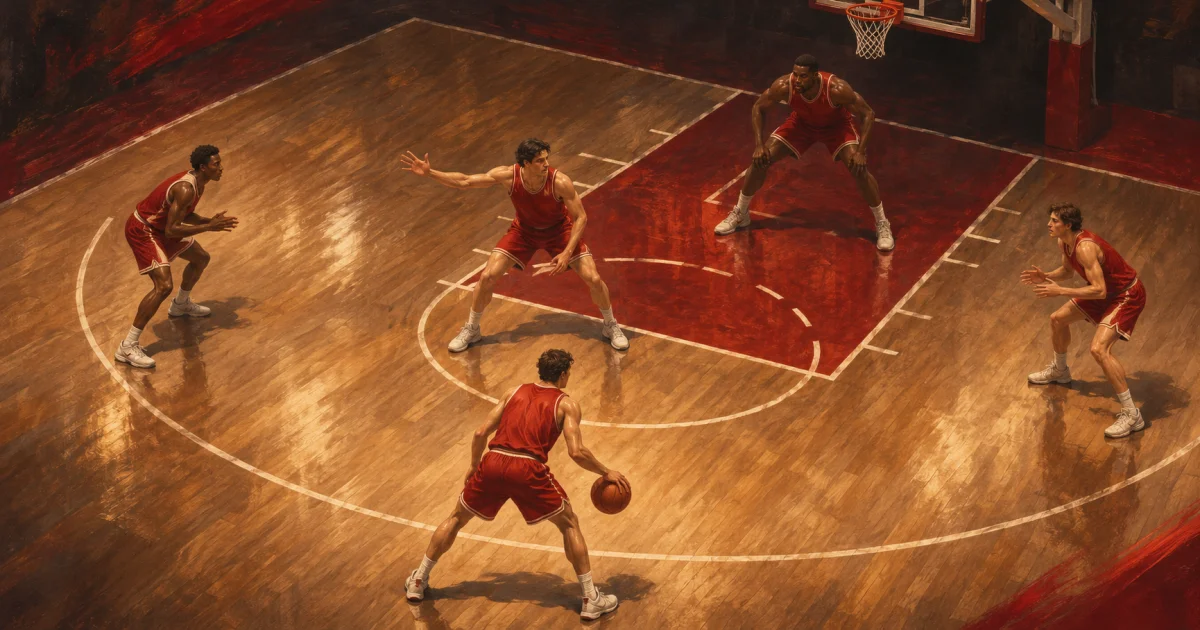
Original editorial illustration.
A plain-English guide to the five basketball positions—PG, SG, SF, PF and C—how each role works, myths to avoid, and what to watch in live games.
The five positions, in plain English
Basketball uses five on-court roles: point guard (PG), shooting guard (SG), small forward (SF), power forward (PF) and center (C). At any moment, a team fields five players, and coaches mix these roles to balance ballhandling, scoring, size and defense.
Think of it this way: guards steer the offense and defend on the perimeter, forwards blend scoring and size on the wings, and the center anchors the paint. Modern teams blur these lines, but the five-role framework still helps you read a game quickly.
Rule context used in this explainer: we reference the NBA Playing Rules (2025–26 edition) and the WNBA Official Rules (2026). Both codify five active players and include three‑second and eight‑second violations that shape where and how each role operates.
Point guard: the organizer
The point guard is the on-court organizer. They bring the ball up against pressure, trigger actions (like a high pick‑and‑roll) and make sure the right scorer touches the ball in the right spot.
Hypothetical example: with 18 seconds on the shot clock, the PG calls “horns,” uses a screen, draws two defenders, and kicks to a corner shooter. No points are recorded yet; just good process that creates an open look.
What to watch: how quickly the PG beats the eight‑second count into the frontcourt, their pace changing (slow to fast), and how they manipulate help defenders with their eyes and dribble.
Wings: the scorers and spacers
Shooting guards and small forwards are your wings. The SG often spaces to the arc, sprints off screens, and attacks closeouts. The SF is typically the most flexible piece; able to guard multiple positions, cut without the ball, and post smaller defenders.
Hypothetical example: the SG relocates after a drive, receives a skip pass, and either shoots or pump‑fakes into a two‑dribble pull‑up. The SF times a baseline cut the second their defender turns to help on the drive.
What to watch: wing spacing (are they flattening to the corners or lifting above the break?), decisiveness on catches, and whether wings communicate switches cleanly on defense.
Bigs: the screeners, anchors and finishers
Power forwards and centers play more in the lane and at the elbows, setting screens, rebounding, protecting the rim and finishing. The PF may stretch to the perimeter (“stretch‑four”) to open driving lanes; the C often sets the tone defensively as the last line.
Rules shape their choices. Offensive and defensive three‑second rules mean bigs can’t camp in the paint on either end, so great PFs and Cs are constantly stepping in and out, screening, and re‑positioning.
Hypothetical example: a C sets a screen, rolls hard, pauses outside the lane to avoid a three‑second call, then seals for a deep catch. A PF screens away to free a shooter, then “ghosts” a second screen to pop for a jumper.
What to watch: screen angles, box‑outs on both free throws and live play, and how the center organizes back‑line help.
Common misunderstandings to drop
Common myths: that positions are fixed, or that size alone defines your role. In reality, coaches assign responsibilities, not labels. A tall forward might initiate offense; a guard might screen because it forces mismatches. Another myth: “guards don’t rebound.” Elite perimeter players crash from the wings precisely because bigs are battling box‑outs.
Also, “positionless” doesn’t mean “structureless.” Even five‑out spacing has rules of engagement; drive, kick, cut, and fill; with players swapping spots as actions flow. The names help you identify tendencies; they don’t confine players to a box.
What to watch during a game
Follow the PG’s first dribble and the nearest screener; this duo often tells you the play. Track weak‑side wings: do they cut behind ball‑watching defenders or drift into passing lanes? Glance at the center’s feet: are they in and out of the lane on time to avoid a three‑second violation while staying ready to protect the rim?
On defense, scan for matchups and coverage calls. A switch puts a big on a guard; now look for a clear‑out or a quick post‑feed the other way. After a miss, spot who sprints wide to the corners (wings), who trails for a top‑of‑arc three (PF), and who runs to the rim (C). With these cues, the five roles; and how they work together; become obvious in real time.