
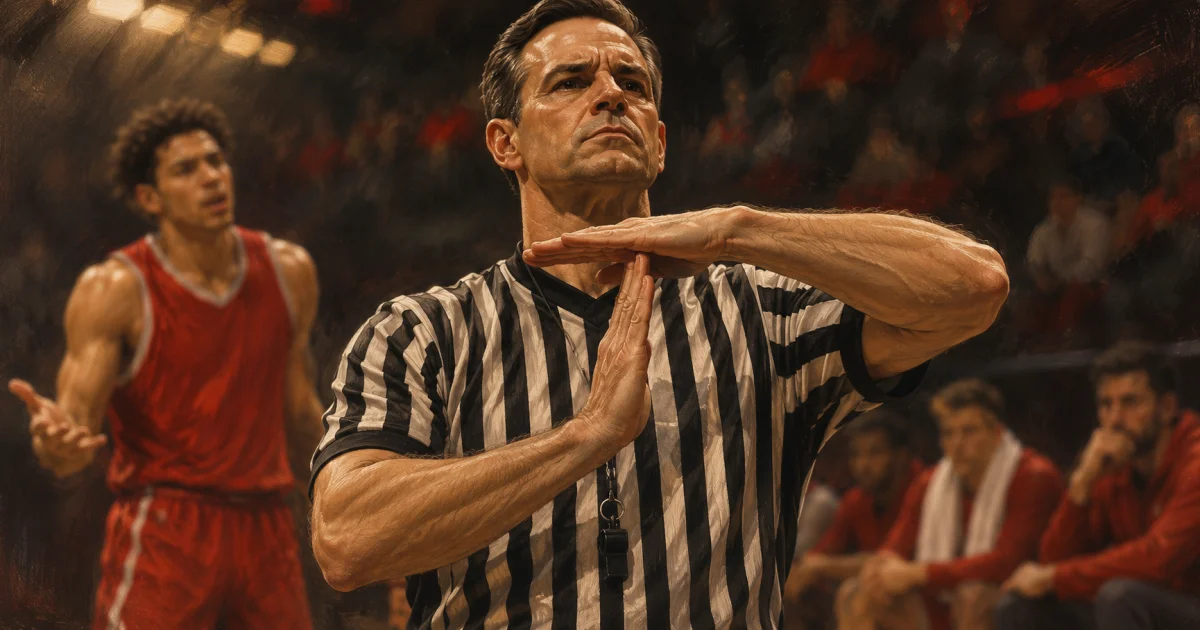
Original editorial illustration.
A technical foul in pro basketball means one free throw and, usually, play resumes at the point of interruption. Here’s how calls, penalties, and examples work.
Quick answer
In the NBA and WNBA, a technical foul is the penalty for unsportsmanlike conduct or certain non-contact violations by players, coaches, or bench personnel. It results in one free throw, and in most situations the ball then goes back to the team that had possession at the time of the whistle (the point of interruption). A properly assessed double technical results in no technical free throws; two separate technicals do not automatically become a double technical just because they occur during one stoppage. Any player who was in the game when the tech was assessed may shoot the free throw, and two unsportsmanlike technicals on the same person require ejection. This explainer uses the NBA’s 2025–26 playing rules and the WNBA’s 2026 rule book as references.
How a technical foul is administered
Here’s what you’ll see when a tech is called: the official signals the technical, and the offended team selects an eligible player for the technical free throw. If the tech was assessed to the defense after a personal foul on that same team, the technical free throw is shot first.
After the shot, the ball is usually awarded back at the point of interruption to whichever team had it when the whistle blew. That’s the default restart for most technicals.
Important exceptions exist. For an excessive timeout or certain wrong-number-of-players errors, the team that shot the technical free throw receives the ball for a throw‑in (or specialized resets apply in the too‑many‑players scenario). These are specific carve‑outs in both pro rulebooks.
Common ways a tech happens
Unsportsmanlike acts. Disrespectfully addressing or physically contacting an official, taunting, or other behavior the referee deems detrimental will draw a technical. Accumulating two unsportsmanlike technicals means ejection.
Administrative/non‑unsportsmanlike techs. Delay‑of‑game, defensive three seconds, being on the floor with too many or too few players, and hanging on the rim can also be penalized with a technical; but the leagues classify these as non‑unsportsmanlike. They still produce one free throw, but they do not count the same as an unsportsmanlike “T” toward ejection.
Dead‑ball contact. Illegal contact during a dead ball can be ruled a technical (if it’s unsportsmanlike) or upgraded to a flagrant if it’s unnecessary/excessive. The distinction is a judgment call tied to the level of contact.
Double technicals. When officials assess a double technical to opponents, no technical free throws are taken. Separate technicals during one dead ball are not necessarily administered as a double technical. Possession resumes as if no free throws were awarded.
Common misunderstandings, clarified
Possession myths. A single technical does not automatically give the shooting team the ball. In most cases, the ball goes back to the team that had it before the whistle; only defined exceptions (like excessive timeouts or certain too‑many‑players errors) change who inbounds.
Who shoots. The shooter need not be the player who was just fouled on the previous play; any player who was legally in the game when the tech was called may take the shot. Hypothetical: if Team A’s bench receives a technical during a stoppage, Team B chooses an eligible player to shoot. The team charged with the technical does not take that free throw.
“Two techs and you’re out.” That shorthand refers to two unsportsmanlike technicals on the same individual. Non‑unsportsmanlike technicals (such as delay‑of‑game) are categorized differently in the rules.
Double‑tech confusion. Spectators often expect a free throw after every “T.” If the officials assess a double technical, no technical free throws follow. That’s by design to avoid advantage either way.
What to watch during a game
During live action, watch for these cues to understand the consequence fast.
- The signal. Officials form a “T” with hands; that’s your first clue a free throw is coming. If two opponents jaw and get offsetting techs, officials will often indicate both sides; then skip the line because no shots are awarded.
- The order of shots. If a personal foul and a technical are both on the defense, the technical free throw is administered first, then any personal‑foul shots or a throw‑in. This sequencing matters late in games.
- The restart. After most techs, look for the inbound at the nearest spot where play was interrupted; clocks and possession state resume accordingly. When the tech was for an excessive timeout, expect the shooting team to inbound instead.
- Ejection risk. Track whether the behavior was ruled unsportsmanlike; a second such “T” on the same individual means they’re done for the night.