
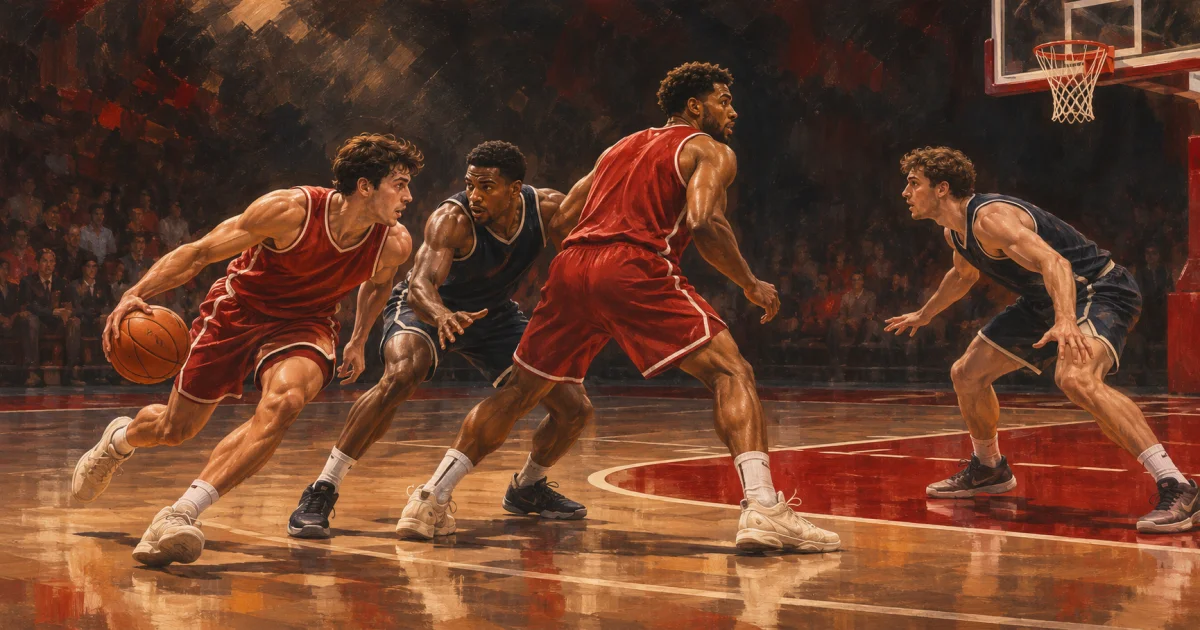
Original editorial illustration.
A clear, game-ready explainer of basketball’s pick-and-roll: what it is, how it works, the legal screen rules, common mistakes, and what to watch in live games.
The short answer
A pick and roll is a two-player action where a screener legally blocks (screens) the on-ball defender, the ball handler uses that screen to turn the corner, and the screener then turns toward the basket to become a passing option. A pick-and-pop is the related variation in which the screener moves out for a shot instead. It’s legal only if the screen itself is legal under the rules. The NBA and WNBA both define a screen as a legal action that delays or prevents a defender from reaching a spot, provided it doesn’t cause illegal contact.
Key legality points: the screener must give a moving defender room to avoid contact, can’t move into the defender, and once set may move only in the same direction and path as the opponent. Illegal contact on a screen is an offensive foul and the ball goes the other way.
How it works, step by step
Picture this hypothetical: your point guard dribbles at the top. A center steps beside the defender to set a firm, stationary ball screen. The guard drives off the screener’s shoulder; the defender is caught behind. The screener turns and dives to the rim. If help rotates, the guard can pass to the rolling big for a layup; if help sinks too deep, the guard pulls up.
Variations abound. A pick-and-pop keeps the shooter behind the arc. A short roll stops around the foul line for a quick pass-and-shoot or pass-and-cut. You’ll also see “empty corner” pick and rolls (the corner on the side of the action is unoccupied) and “angle” screens set on the side to force drives to the middle or baseline.
Common misunderstandings and violations
Misread: “Screener can shuffle to make sure the defender hits them.” Not quite. The screener must allow space; often one to two normal steps depending on the defender’s speed; and may not move laterally into the defender after establishing position. Failing to give that space or moving into contact makes it an illegal screen.
Misread: “If the ball handler runs a defender into a teammate, it’s always the screener’s foul.” Not necessarily. If the ball handler barrels through or charges, that can be an offensive foul by the dribbler; ball handlers must control their body and avoid established defenders.
Edge case to know: you can’t step out of bounds along the endline in the frontcourt to set a screen. That’s a violation in both leagues and results in a turnover at the sideline.
How defenses play it: and the reads
Defenses try to deny the advantage in a few standard ways, and seeing the first two steps will tell you which one is coming.
Go over: On-ball defender fights above the screen to stay on the guard’s hip. Watch for the ball handler to drive or snake back into the lane if the big is in a deep drop.
Go under: Defender dips below the screen to cut off the drive. Offenses counter with a quick pull-up three or by flipping the angle for a re-screen.
Switch: Defenders trade assignments on the fly. The offense hunts mismatches; post the rolling big on a guard or isolate the ball handler on a slower big.
Blitz/hedge: Two defenders jump the ball. The release valve is the short roll to the foul line, where the screener makes a fast read to the corners or dunker spot.
What to watch in real time
On each ball screen, scan three things quickly.
1) Screener’s setup: Are the feet set and the torso still, with hands tucked? If the screener extends arms, leans a hip, or widens legs outside a natural stance to make contact, you’re likely seeing an illegal screen. The NBA Video Rulebook shows typical examples such as two-hand pushes or legs splayed outside shoulder width.
2) Space for the defender: Did the screener give the on-ball defender a fair chance to avoid contact? If not; especially when the defender is moving fast; that’s on the screener.
3) The roll lane: After the screen, does the screener release toward space without illegally holding or knocking a defender out of the way? A player can roll toward the basket; the rule about moving in an opponent’s path concerns maintaining a legal screen, not a requirement to roll in one fixed direction. Clean rolls open lobs and pocket passes; veering invites a whistle.